Welcome To Wetlands Trails Walking

Rocky Narrows
Sherborn MA Trails The “Gates of the Charles.” In 1897, Frederick Law Olmsted, Jr., acting as an acquisition agent for Augustus Hemenway, deeded to The Trustees 21 acres on the Charles River known as Rocky Narrows, the “Gates of the Charles.” It became The Trustees’ first reservation, populated with a mixed forest of hardwoods and…

Ashland Town Forest & Cowassock Woods
Sudbury Valley Trustees Ashland Town Forest & Cowassock Woods is a 660-acre parcel of open space located in Ashland and Framingham. This area has a natural wealth of granite outcroppings, upland and lowland swamp, vernal pools, mixed hardwood forest and several open pit quarries. The Ashland Town Forest is managed by the Town Forest Committee…

Cedariver Trail
Millis MA The Trustees of Reservation Explore this former riverside farm along the carriage road loop or enjoy a leisurely paddle on the Charles. Cedariver boasts beautiful frontage along the Charles River, and serves as a prime spot for paddlers to land their boats and take a hike. Situated within a river environment serving both…

Garlic Mustard
Garlic mustard (Alliaria petiolata) is an invasive biennial weed. This article displays images to assist with identification and provides recommendations for control, including a management calendar and treatment and timing table. Background Garlic mustard (Alliaria petiolata) is an herbaceous member of the mustard family (Brassicaceae) brought over by early European colonizers. First documented in New…

Oriental Bittersweet
Background Oriental bittersweet (Celastrus orbiculatus) was introduced to the United States in the 1860s from east Asia. This woody, deciduous, perennial vine has since naturalized and become an extremely aggressive and damaging invader of natural areas. Oriental bittersweet chokes out desirable native plants by smothering them with its dense foliage and strangling stems and trunks.…
Autumn Olive
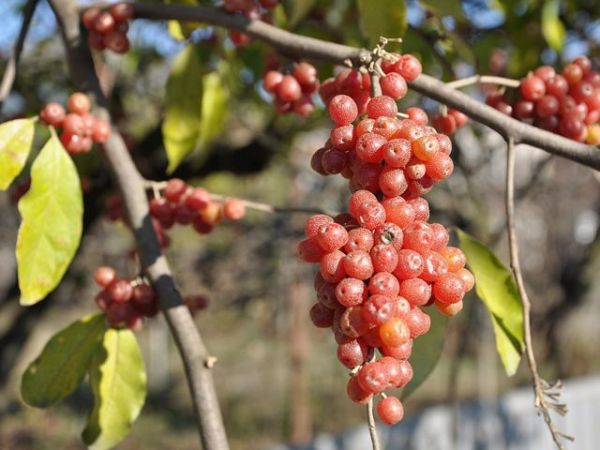
Autumn olive trees were planted for soil erosion. But its prolific fruit and seeds have disrupted native ecosystems. Scientific Name: Elaeagnus umbellata Introduction: Brought to U.S. from Asia in 1800s, planted widely in 1950s for erosion control. Identification: Grayish green leaves with silvery scales bottom side, gives off shimmery look. Stems are speckled, often with…
 WETLANDS TRAILS WALKING